Video transcript
Hello, my name is Mairtín Davy Ó Coisdealbha and I’m from Inverin or Indreabhán, County Galway. I was brought up very near the sea because we had to at that time, as it was the only food we could get. We couldn’t even travel to Galway because we only had one or two buses per week.
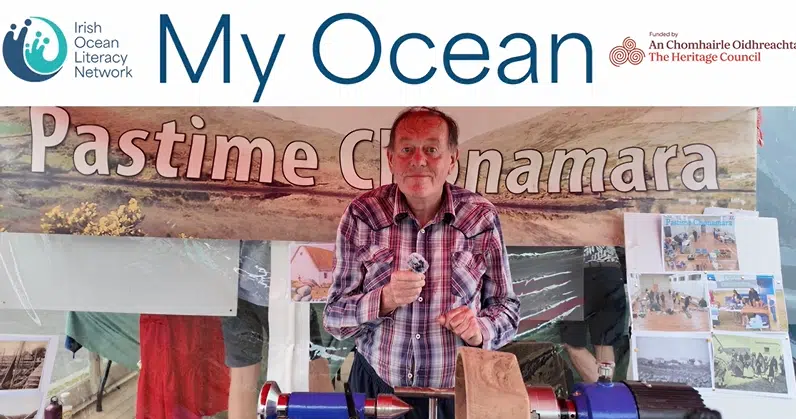
I spent 30 years as a broadcaster with RTÉ Raidió na Gaeltachta, and in the last three or four years I do different exhibitions and talks about woodturning and crafts, especially at Cruinniú na mBád. I was the first person who made a television documentary on the first-ever Cruinniú na mBád—I think it was about the first year they were there anyway.
I remember coming in here to Connemara on a very wet evening, and I always remember people like Joe Pilkington, the actor, Bob Quinn, who made the film, and a lot of other people who are gone now who talked about that evening and the connection they had with Connemara, the turf boats, currachs, and many things in this area. So, I’m glued to tradition with this particular area anyway.
As I said, I was born and bred near the seashore in Inverin, County Galway, in Indreabhán. When I was very young, I had to go pick periwinkles with my mother, as well as Carrageen moss, dillisk, and Sluachán, as they used to call it—or sea lettuce. We used to sell it for 10 shillings a bag every Saturday.
It meant a lot to me because we had no bathroom or running water, and we had to wash ourselves nearly every second day. There were a lot of cures we could get from the broad seaweed, Fucus vesiculosus, Laminaria, and a lot of other species of seaweed. A lot of them are edible, but many people would mix up the edible ones and use the others for the donkeys, cows, and especially the pigs.
I enjoyed going down with my mother and father to gather periwinkles—not the barnacles, but the periwinkles—and we used to eat them. I think I was about 12 years of age before I ever saw a sausage or a rasher. The people who were well-off in the area used to kill a pig, so they had their own rashers, but we never had that.
So, from the sea, the seashore, and the rocky part of the coast, we used to collect a lot of things like driftwood.
That’s the reason I’m very interested in driftwood today. As you can see here, I work with driftwood and also giúsach—the bog oak and bog yew—which is really the platform under the sea that goes straight up to the bog. People think the bog ends up there, but no, it starts under the sea.
We were all connected to the seashore, the bog, and the environment surrounding it. Until this day, when I see people selling remedies of Carrageen in health shops and so on, they know about them in a way—they know the scientific part—but they don’t know the cultural side that we experienced.
Really, we hated gathering them because we were wet, nearly got pneumonia, and nearly had insects eating our Wellington boots at the time. We used to go down with two slices of bread, and it was so wet that we could taste the salt—the sodium chloride—when we ate it. But we didn’t know the difference; we thought that was how everybody lived around us. Today people talk about four-star, five-star, or six-star hotels. We only started with one star, and that was the fish star we saw on the seashore afterwards.
I must say it meant a lot to our minds. It meant a lot to be very satisfied, number one, and number two, to enjoy the environment surrounding you. We didn’t know about depression or anxiety; we didn’t know about anything. If a person was overly anxious, we would say he didn’t have enough work to do or couldn’t be kept busy, so we’d bring him onto the seashore or up on the bog. That was the natural cure and the natural way of looking after people.
I’m afraid nowadays that’s all gone, and it’s called medication now more than anything else. We used to call it a cure, but that’s another story.
Nowadays we look back and make documentaries for TV and radio about what we did, but I think we should move away from documentaries and look at real life to see exactly what’s happening around our sea and seashore today. From the trawlers passing by to septic tanks and various other things, I don’t think I’d like to be eating periwinkles anymore.
I think things should be scrutinised and looked after carefully. Because if that goes—if the seashore goes and the healthy seashore life goes—that’s the end of Ireland. That’s the end of Connemara.
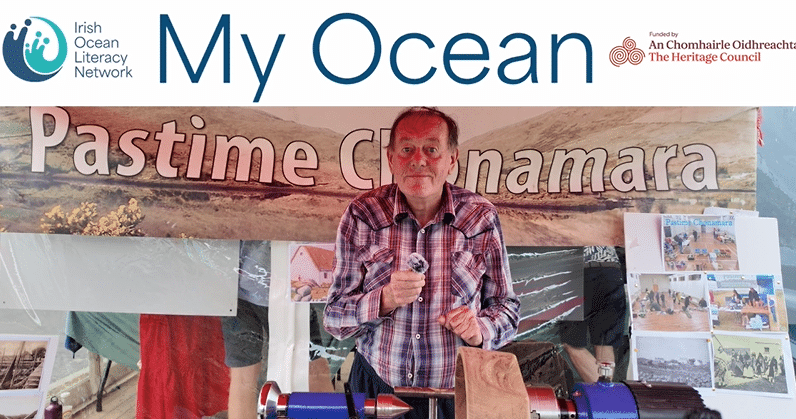
Mairtin Davy