The ocean covers approximately 70% of our planet’s surface. While maps often show different names for various regions, there is only one ocean, connected through a global cycle of evaporation and precipitation. Nature does not recognise the boundaries we draw; it is all one ocean, where marine life moves freely across the globe.
The ocean is much more than a resource for food, energy, or transport. It is a fundamental part of our cultural identity and heritage, woven into our art, language, and music.
Ocean Literacy is defined as an understanding of the ocean’s influence on you, and your influence on the ocean.
Ocean literacy was initially developed in 2004 by a group of U.S. scientists and educators to address the scarcity of ocean sciences in formal education. It has since significantly evolved from its original education- focused framework towards a global movement promoting sustainable interactions with the ocean.
There are seven Ocean Literacy principles which remain a work in progress; they reflect the global efforts to date in defining ocean literacy. Download the orginal ocean literacy concept and principles here.
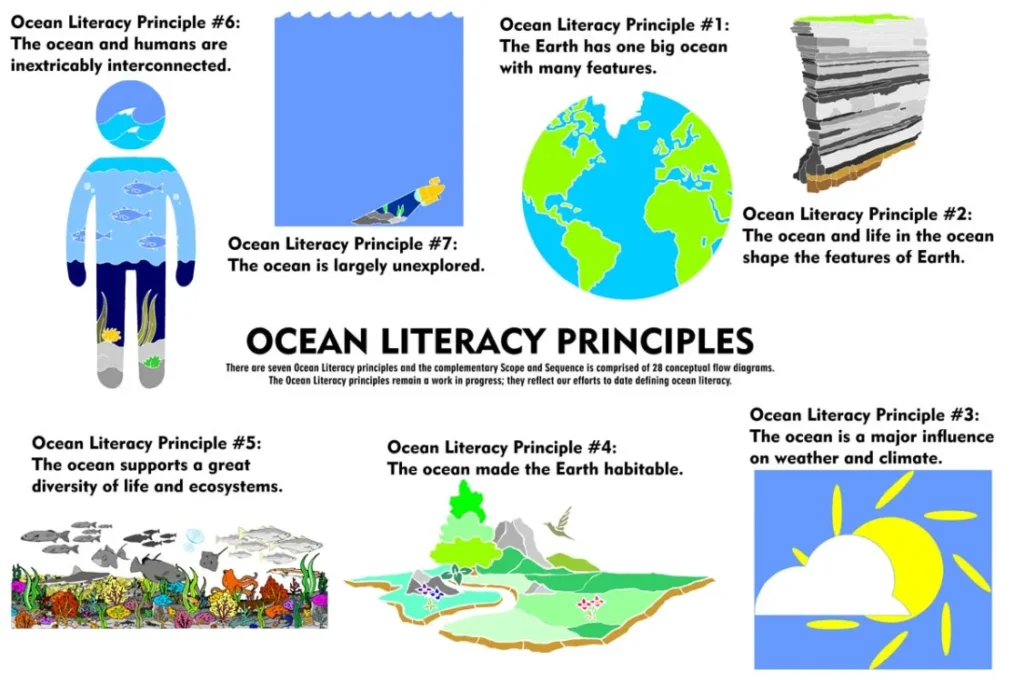
The SEVEN principles of Ocean Literacy images were created by Garry Kendellen, Irish Ocean Literacy Network.
For a version of the Ocean Literacy Principles as Gaeilge please email irishoceanliteracynetwork@gmail.com
Ocean literacy has moved beyond the classroom to become a global movement. Today, there is a worldwide push to reverse the decline in ocean health through international frameworks such as the UN Decade of Ocean Science and the EU Mission ‘Restore our Ocean and Waters’.
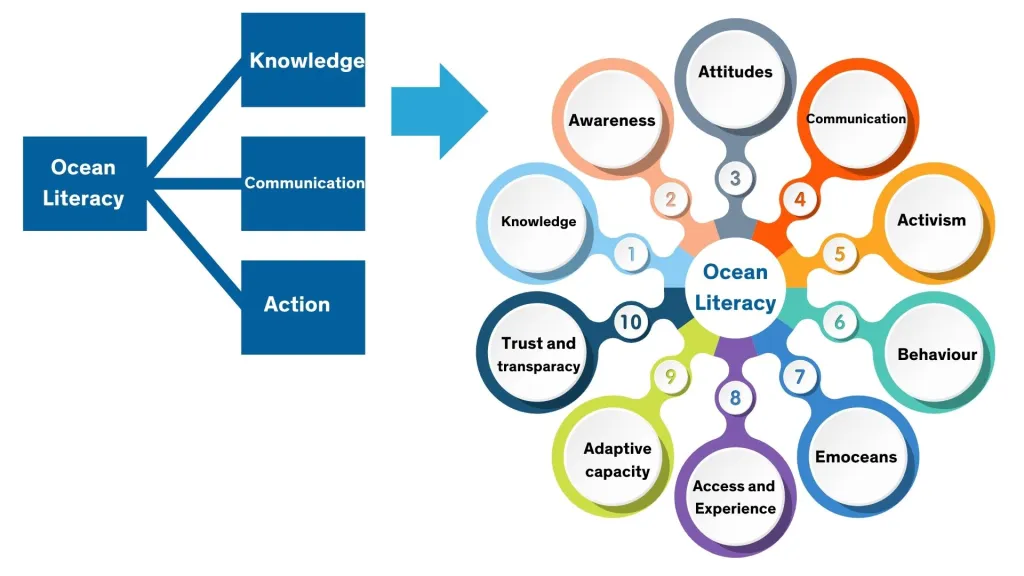
Contemporary models of Ocean Literacy have introduced a more nuanced approach, incorporating awareness, knowledge, attitude, communication, behaviour, emotional connections, access and experience, adaptive capacity, trust and transparency, and activism as new dimensions, acknowledging the complexity of factors influencing pro-environmental behaviour and the necessity of transforming knowledge into meaningful action for ocean sustainability (McKinley et al., 2023).
The United Nations Decade of Ocean Science for Sustainable Development (2021–2030) has made Ocean Literacy central to its mission. Coordinated by the Intergovernmental Oceanographic Commission of UNESCO, the Decade set out to build “the science we need for the ocean we want,” with Challenge 10 focused on restoring society’s relationship with the ocean.
In June 2024, UNESCO-IOC brought international experts together in Venice for the first Ocean Literacy World Conference. The result was the Venice Declaration for Ocean Literacy in Action, a statement of intent for the global Ocean Literacy community. The IOLN was part of the expert group that helped draft the Declaration, giving Ireland a direct hand in shaping this global framework.
That work carried through to the UN Ocean Conference in Nice in June 2025, where Ocean Literacy was formally written into the resulting political declaration, Our Ocean, Our Future: United for Urgent Action — a marker of how far Ocean Literacy’s standing in international policy has come since it was first defined in 2004.
Ocean Literacy is also growing through associations such as the IOLN, European Marine Science Educators Association (EMSEA), Centre for Ocean Literacy Collaboration, International Pacific Marine Educators Network (IPMEN), EuroGOOS Ocean Literacy Working Group, and the Australian Association for Environmental Education (AAEE). It is becoming a key policy focus for governments, for example, Y Môr a Ni (The Ocean and Me), a framework for Ocean Literacy in Wales.
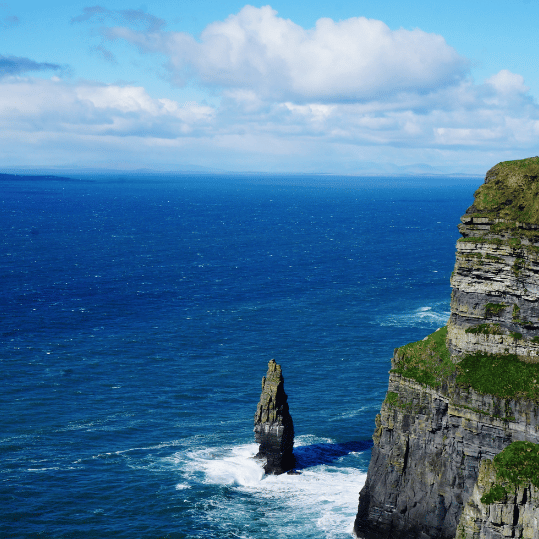
For Ireland, the ocean is a fundamental part of who we are. It is woven into our coastal communities, our economy, our art, and the Irish language.
As an island nation, Ireland manages 880,000 square kilometres of marine environment; an area nearly ten times the size of its landmass. With one of the largest marine territories in Europe, approximately 40% of the Irish population lives within 5km of the Irish Sea or Atlantic Ocean and depends on it.
When we talk about the ocean, we often focus on its monetary value, but we need to think much broader than that. To truly protect it, we must recognise the deep emotional, social, and historical connections that make the ocean a priceless part of our lives.
A recent survey by the Horizon Europe EmpowerUs Project found that 82% of Irish people are willing to change their lifestyle if they knew that it would help the ocean. They want to see more ocean science in schools, more ocean stories in the media, and a real celebration of our cultural ties to the water.
Ocean literacy is the bridge that helps us move from simply caring about the ocean to taking the informed action needed to protect it. It moves the ocean from being a distant resource to something real and accessible in our daily lives.
Established in 2016 and formally incorporated in 2023, the Irish Ocean Literacy Network (IOLN) brings together a diverse community passionately committed to our ocean. Our core mission is to nurture a sustainable community of ocean-literate citizens across the island of Ireland. We believe that by working together, we can improve coordination and capacity building to help achieve our common vision of an ocean-literate society.
The Network has achieved something unique. While other countries and EU states are still exploring how to coordinate national efforts, Ireland already has a sustainable, established network of practitioners delivering on-the-ground work. We enable our Members to coordinate these existing efforts and share practical knowledge. By connecting active practitioners, we ensure that our collective action achieves tangible, measurable impacts on society.
The Network consists of a broad range of sectors, including NGOs, public bodies, researchers, educators, private enterprises, and individuals across the island. Through advocacy, public awareness campaigns, and outreach, our Members collaborate to advance ocean literacy and protect our shared marine environment.