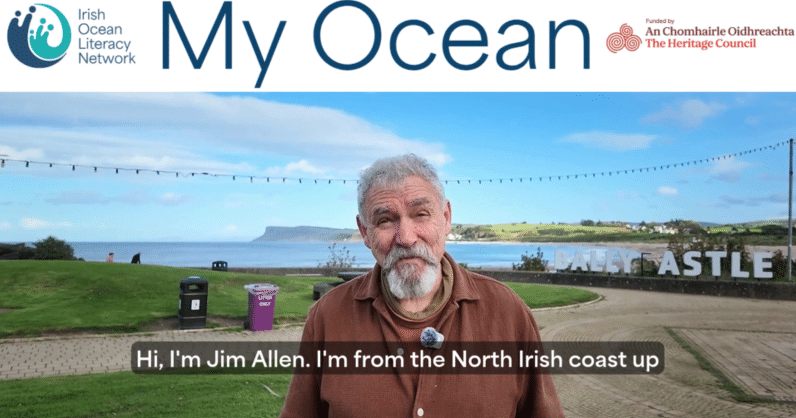
Hi, I’m Jim Allen. I’m from the North Irish coast up here in County Antrim at the very top of Ireland, and I’m very happy to be standing beside the Atlantic Ocean with over my shoulder. And what does it mean to me?
If I could quote The Waterboys, when people from Belfast say, “Isn’t the sea beautiful?” and I say, “That was a river, but this is the sea. You’ve only got a sea, we’ve got an ocean.” It was a bit like—I suppose I thought I was thinking about Crocodile Dundee, who says, “That’s not a knife, this is a knife.”
So what does the ocean mean to me? I was born and raised in a small council housing estate four miles from the sea inland, from the sea in a place called Coleraine, and my mother was a storyteller, a natural storyteller. She was the daughter of a Portrush fisherman, a Drontheim fisherman, which is a strange name for a double-ended boat which came from the Vikings. But she taught me stories about her father, my grandfather, who was a Drontheim fisherman.
She just painted the sea. In a little bedroom, a two up two down in a housing estate in Coleraine, I could smell and taste and hear the sea. And I knew every inch of Portrush where she came from before I even seen it, but once I seen it, that was it. I was completely sold, and I spent most of my adult life playing on the sea. I did a wee bit of work, too, on the sea. So once you’ve ever put your foot on a boat on this particular type of ocean, and we’re surrounded by it, it just captures you right away.
I’m also an artist and I love painting the sea, and I’m a storyteller. I love talking about the sea, even when I go out playing music about the sea. But anyway, what does it mean to me?
I feel that I can see my horizon. When I can see my horizon, I can breathe. It just fills your lungs because you can see so far, and I feel so sorry for the folk who live in cities and places like that where they don’t see their horizon. But when you come to the coast, you can see for miles, and it’s that open space that just fills your headspace and your lung space.
And when we talk to children, we often take them out onto Rathlin Island and we teach them about the sea, and we bring them back onto this shore, and we say, “Any hands up, who would like to live on an island?” Two or three of them will put their hands up, but most of them won’t put their hands up, and I say, “You wouldn’t want to live on an island?” They go, “No.”
I’m sorry to have to tell you, you do. This is an island, and I think we’ve forgotten that. I think so many of our people on this island, this beautiful island, have forgotten that this is an island. We’re surrounded by the sea, and a lot of them are surprised and shocked to understand and hear for the first time that their ancestors are boat people. That’s how we got here. We are boat people.
And I think that humbles you a wee bit in today’s age when we think about people on the sea coming from everywhere else. How did we get here? Those were our ancestors. Their ancestors were our ancestors. It kind of levels out a wee bit.
So the ocean can mean an awful lot of things to an awful lot of people, but to me, no better place.