“What a fantastic networking event it was! So much good vibes and generous spirit to enable real change in our understanding of the seas and its heritage all across the island of Ireland”. Prof. Maxim Fomin, Ulster University
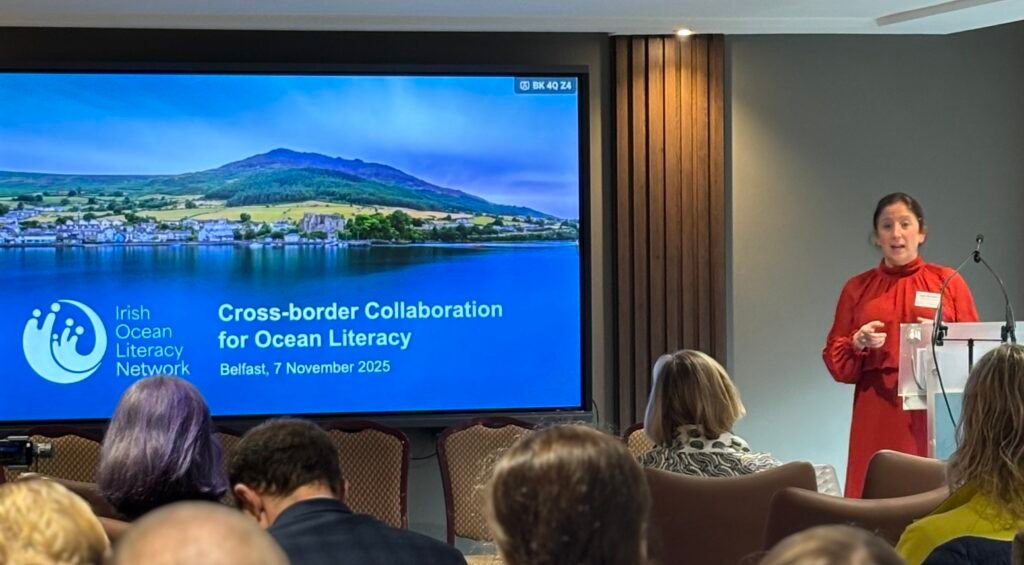
On 7th November, the Irish Ocean Literacy Network hosted a regional meeting at the Europa Hotel, Belfast. The theme was ‘Cross-border Collaboration for Ocean Literacy’.
The event brought together a wide range of attendees, from grassroots community groups and artists to researchers and policymakers, to discuss the challenges of working across borders and share practical examples from the ground.
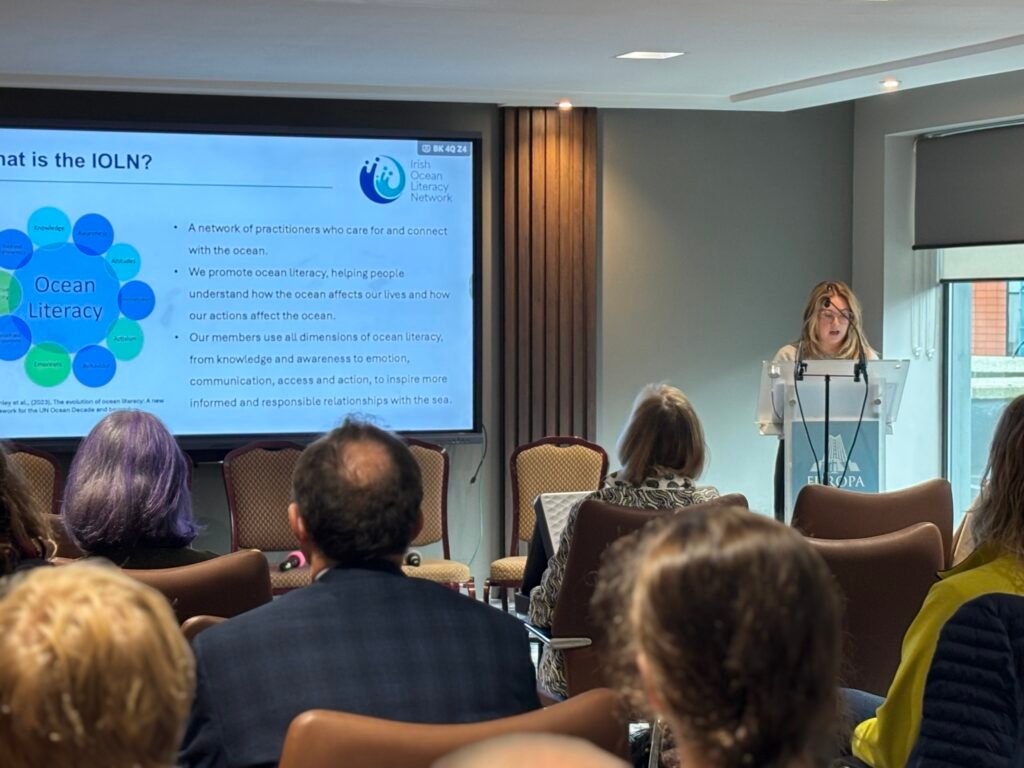
Setting the Scene: Passion vs. Perception
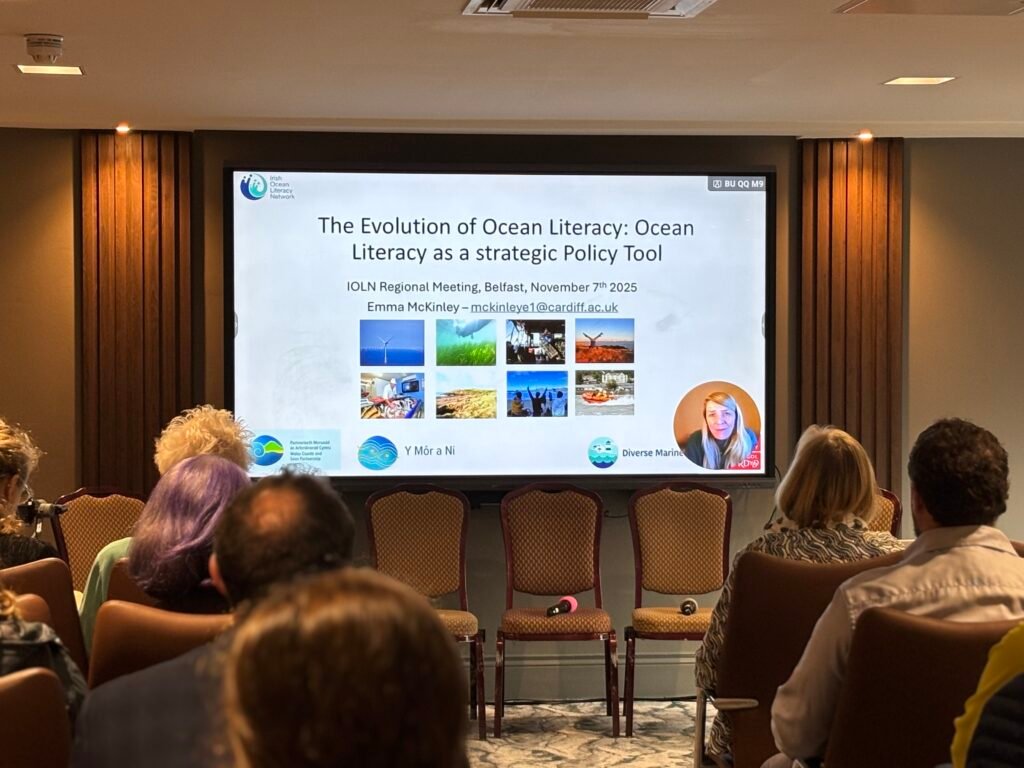
To kick off the session, Dr Emma McKinley (Cardiff University) joined us virtually to deliver her keynote speech on ‘The Evolution of Ocean Literacy as a Policy Tool’.
Emma’s talk highlighted a major shift in how we define “Ocean Literacy.” It is no longer just about science education in schools — it is a mechanism for social change that needs to involve the whole of society, including non-coastal communities. She discussed the “10 Dimensions of Ocean Literacy,” which now includes factors such as emotional connection, access, trust, and adaptive capacity.
This was complemented by Hugh Edwards from DAERA, who presented the ‘Ocean Literacy Headline Report for Northern Ireland’.
Between Emma’s insights and Hugh’s data, a stark contradiction emerged: While 82% of people in Northern Ireland say protecting the marine environment is personally important to them, 34% believe their lifestyle has “no impact” on it.
The message was clear: We have the passion, but we are missing the connection to action. To bridge this gap, we must move beyond the “usual suspects” and engage all communities and policy sectors that don’t traditionally look at the sea.
Watch the recordings:
- Dr Emma McKinley, ‘The Evolution of Ocean Literacy: Ocean Literacy as a Policy Tool’
- Hugh Edward (DAERA), ‘ Ocean Literacy Headline Report, Northern Ireland’
Read: Emma’s work in Wales helped deliver, Y Môr a Ni (The Ocean and Me), a framework for Ocean Literacy in Wales and the world’s second national Ocean Literacy strategy.
Panel 1: Grassroots to Policy
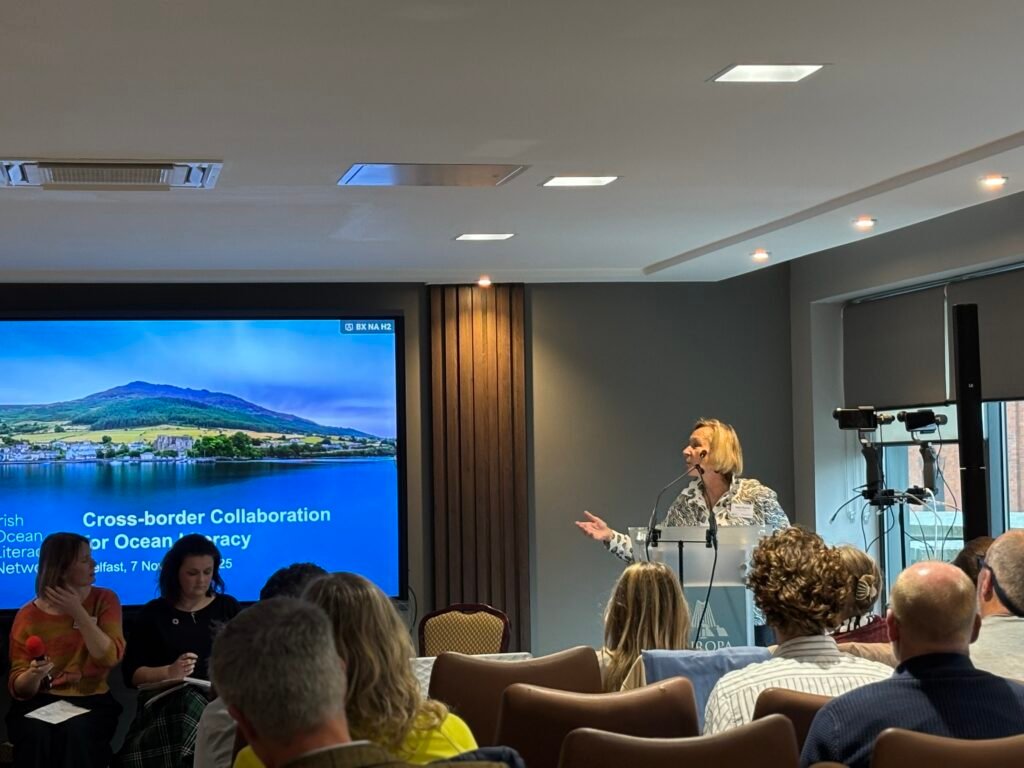
Our first panel, moderated by Kate Burns, asked a difficult question: How do we connect on-the-ground work to real policy?
A recurring theme was that Ocean Literacy in Ireland has largely been driven by people with passion, rather than at policy level. While there is incredible work happening all around the island of Ireland, it needs to be better linked to policy frameworks to have a lasting impact.
We moved from the practical to the political, covering a wide range of perspectives on collaborating across borders.
- Erin McKeown (RSPB): Using the example of terns — seabirds that rely on a breeding network from Larne to Rockabill — Erin illustrated why nature cannot be managed by borders.
- Ciara Brennan (Environmental Justice Network Ireland): Ciara delivered a stark update on the legal landscape, warning that post-Brexit regulatory divergence is already happening. She also discussed the need for cross-border public consultation on major infrastructure projects.
- Andrew Ward (Inishowen Development Partnership): Speaking from a fishing background, Andrew addressed our “sea blindness” and the sense of betrayal often felt by coastal communities. He argued that for ocean literacy to work, fishers must be central partners, citing the transformative ‘Fogo Island’ process as a model for community renewal.
- Dr Sarah McClean (Loughs Agency): Sarah described the unique position of the Loughs Agency as a cross-border body managing catchments as single bio-regions. She highlighted the move toward ecosystem-based management and using new tech such as ‘Digital Twins’ to help communities visualize complex marine data.
- Aoife Ní Lochlainn (Irish Environmental Network): Aoife shared insights from the All-Island Civil Society Forum, emphasising that while dialogue is good, we need to manage the tensions between sectors (such as offshore wind vs. biodiversity) through shared data and mapping projects.
Watch the panel recording
Panel 2: Ocean Literacy in Action – Stories of Practice
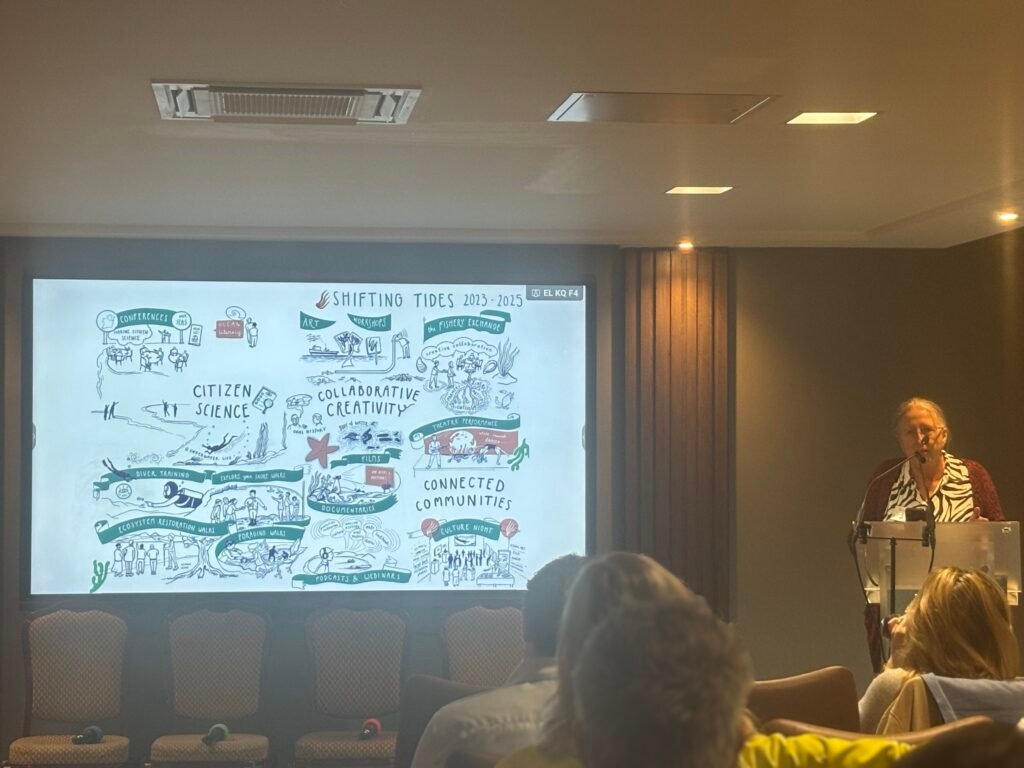
In the afternoon, the conversation shifted from policy frameworks to practical application. Moderated by Suzie Cahn (The Wheel), this session, titled ‘Ocean Literacy in Action’, showcased how individuals and organizations are bringing the ocean to life in their communities through art, science, food, and heritage.
- Prof. Maxim Fomin (Ulster University): Maxim demonstrated how modern technology can preserve ancient traditions. He showcased the Maritime Trail AR app, which uses augmented reality to visualise sunken history and folklore, ensuring that local oral traditions and heritage are kept alive for a digital-native generation.
- Maggie Finlay (Beach Schools NI): As the founder of the only Beach School in Northern Ireland, Maggie spoke about the transformative power of simple, hands-on access. She highlighted that taking children out of the classroom and onto the shore doesn’t just educate the child — it often re-engages parents and grandparents, creating a multi-generational ripple effect of curiosity.
- Dr Lindsay West (Queens University Belfast): Lindsay introduced the profound concept of ‘Marine Identity’. Moving beyond the idea of ‘connection’, she explained how for many coastal communities, the ocean is intrinsic to their sense of self (“Who am I?”). She argued that policy, particularly regarding offshore wind and spatial planning, often fails to account for this deep psychological displacement.
- Rod Cappell (Aquaculture NI): Rod challenged the room to confront our ‘sea blindness’ regarding food. He presented data showing the incredibly low carbon footprint of local shellfish compared to land-based meat, yet noted the irony that we export the vast majority of our sustainable oysters and mussels while importing fish from abroad.
- Diane Cannon (Fanad Lighthouse): Diane shared how Fanad Lighthouse has evolved from a tourist site into a cultural hub. By integrating the Irish language, local music, and oral histories into their tours (such as the “Éist” listening project), they are deepening the visitor experience and preserving the specific cultural identity of the Gaeltacht coast.
- Emma Healey (QUB Marine Lab) & Sam Purdon (Coastal Catchups): Both Emma and Sam discussed the importance of accessibility. Emma highlighted how the QUB Marine Lab uses open days and art workshops (such as seaweed cyanotypes) to demystify science for the Portaferry community. Sam shared how his Coastal Catchups newsletter uses simple, curiosity-driven storytelling to make marine science accessible to non-experts, proving you don’t need a PhD to be an ocean advocate.
Watch the panel recording
“Days like this remind us of the power of connection when knowledge, creativity, and care for our environment come together, amazing things happen”. Diane Cannon, Fanad Lighthouse
If there was one takeaway from the day, it’s that Ocean Literacy needs to belong to everyone. It is not just for scientists or coastal residents; it’s for artists, teachers, farmers, and industry leaders.
While the challenges of cross-border work are real, the willingness to collaborate is strong. As we saw in Belfast, when we get into the same room, the barriers start to break down.