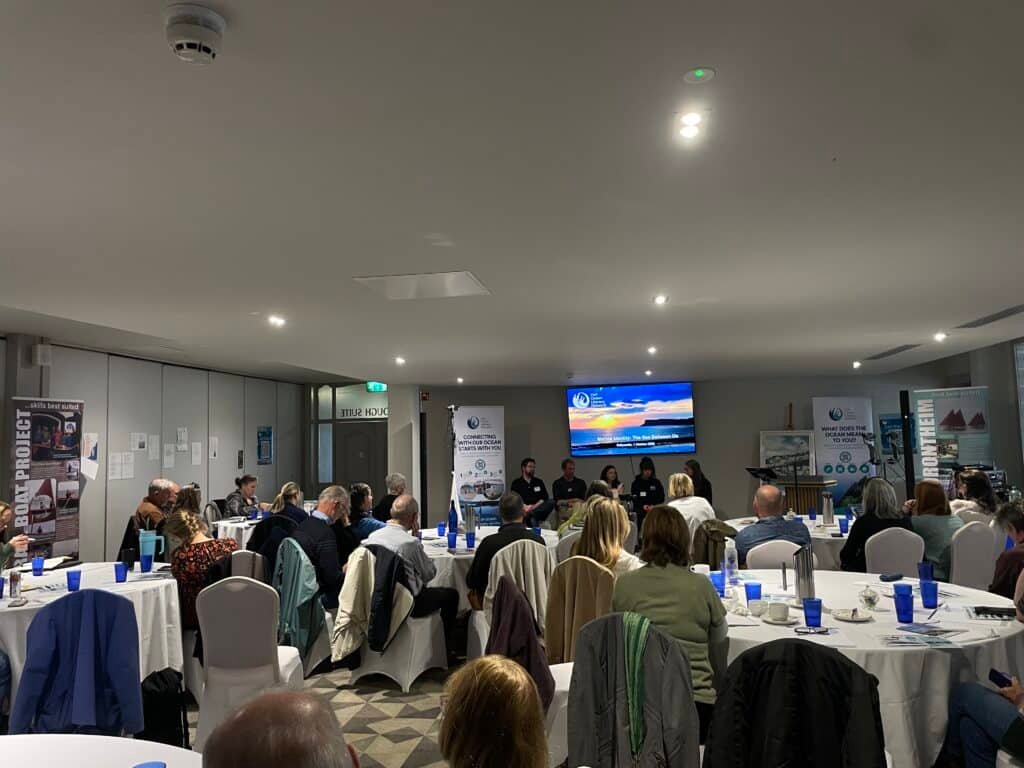
On 1 October 2026, the Irish Ocean Literacy Network gathered in Ballycastle for a day of conversation, storytelling, connection and reflection around “Marine Identity: The Sea Between Us”, exploring the many ways the ocean connects communities across the island of Ireland and beyond — through history, heritage, culture, lived experience and shared futures.
Set against the Sea of Moyle, the day brought together scientists, maritime heritage practitioners, community organisations, educators, policymakers and people with generations of lived experience of the sea. From the historic connections between Ballycastle, Rathlin Island and Scotland to the future of marine conservation, access and community development, the discussions explored how the ocean connects people across borders, generations and disciplines.
Opening the day, IOLN Executive Officer Catherine McCann reflected on the many ways the sea connects people — to place, to one another, to histories and traditions, and to the future. Drawing on the Sea of Moyle as a powerful example, she explored how ocean literacy is about more than knowledge: it is also about relationships, lived experience, culture, memory, access and our capacity to participate in shaping the future of our seas.
Across the Moyle: Myths, Memories and Maritime Connections
The day opened with a keynote from marine scientist and Ulster University lecturer Dr Chris McGonigle, who reflected on the relationship between science, community, place and identity. Drawing on his own experiences growing up on the north coast, working with fishing communities and researching the marine environment, Chris queried the idea that scientific knowledge should sit apart from local and lived experience.
Instead, he highlighted the value of bringing different forms of knowledge together. Scientific knowledge, he suggested, is one part of a much wider picture, and meaningful progress depends on listening to and respecting the knowledge held by communities, fishers, heritage practitioners and others who have long-standing relationships with the sea.
His presentation also highlighted the vulnerability of maritime heritage, from traditional boatbuilding skills to the vessels and stories that have shaped coastal communities. The final operational capacity to build traditional clinker boats at McDonald’s Yard in Greencastle, for example, is under serious threat, raising wider questions about how intangible cultural heritage can be recognised and protected alongside our natural heritage.
The first panel, Across the Moyle: Myths, Memories and Maritime Connections, continued this exploration of the past. Speakers shared stories of the historic connections between Ballycastle, Rathlin Island and Scotland, including fishing, boatbuilding, travel and trade.
The Sea of Moyle emerged not as a barrier, but as a bridge.
For generations, people crossed these waters, exchanged goods and knowledge, built relationships and carried maritime traditions between communities on either side. Stories of traditional boats, family connections and local boatbuilding demonstrated how much of this history survives not only in archives and artefacts, but in the memories and lived experiences of people within coastal communities.
The discussion also highlighted the importance of keeping that knowledge alive by creating opportunities for people to experience it. Modern replicas and fibreglass versions of traditional boats, for example, are enabling new generations to sail and learn in ways that might otherwise have disappeared.
From Heritage to the Future
The afternoon discussions turned towards the future: how can the connections we have inherited help shape more sustainable and inclusive coastal communities?
A recurring message was the importance of access and experience. Living beside the sea does not necessarily mean having access to it. Something needs to bring people across that invisible boundary and into the marine environment — whether through family, friends, education, community activity or simply opportunity. Once people have that experience, it can change their relationship with the sea.
This raised important questions about who feels that they belong in coastal and marine spaces. Discussions touched on gentrification, confidence, accessibility and the risk that blue spaces become places that some communities feel are no longer for them.
There was also a strong call to create more opportunities for children and young people to experience the sea directly. Intergenerational knowledge emerged as particularly important, with speakers reflecting on how their own relationships with the ocean began through parents, grandparents, friends or community members who brought them onto the water.
Rather than simply telling people why the ocean matters, the discussion suggested that meaningful experience can be one of the most powerful forms of ocean literacy.
Connecting Knowledge, Communities and Policy
Across both panels, there was a clear call to break down the silos between science, heritage, education, environmental conservation, the fishing industry, arts and community development.
The conversations demonstrated that people rarely fit neatly into a single category. Scientists are also members of communities. Heritage practitioners can be environmental advocates. Fishers hold generations of ecological knowledge. Artists and storytellers can help people understand the sea in ways that scientific information alone cannot.
There was a particular emphasis on bringing lived and local knowledge into decision-making alongside scientific evidence. Long-term community knowledge can help fill gaps in scientific datasets and provide a deeper understanding of how marine environments have changed over generations.
The discussions also highlighted the need for stronger connections between communities and policymakers. Participants expressed a clear appetite for policy to better reflect the work already happening on the ground, with calls for greater collaboration across government departments and for marine issues to receive greater attention within wider policy and planning.
The connection between land and sea was another recurring theme. From marine litter and biosecurity to the condition of Lough Neagh and the wider health of coastal waters, what happens on land inevitably affects the sea.
Looking Forward
As the day drew to a close, Heidi McIlvenny, IOLN Director, reflected on the many connections that had emerged throughout the event.
There were geographical connections — across Ireland, to Rathlin and Scotland, and further afield through international experiences and collaborations. There were connections between people and communities, between generations, and between different disciplines and sectors.
There were also connections between past and present: the memories and knowledge of those who have spent decades on the water helping us understand what our seas once were, and what we might want them to become.
Perhaps most importantly, the day highlighted the connection between knowledge and experience. Ocean literacy is not simply about knowing more about the ocean. It is also about having the opportunity to experience it, to develop a sense of belonging, and to understand our relationship with the places and communities that depend upon it.
From traditional boats and boatbuilding to marine science, citizen engagement, education and community action, Ballycastle demonstrated the depth of knowledge and commitment already present in coastal communities.
The challenge now is to bring those connections together — and ensure that they have a meaningful role in shaping the future of our seas.
The Sea of Moyle has connected communities for generations. The conversations in Ballycastle asked how those connections can help us shape what comes next.