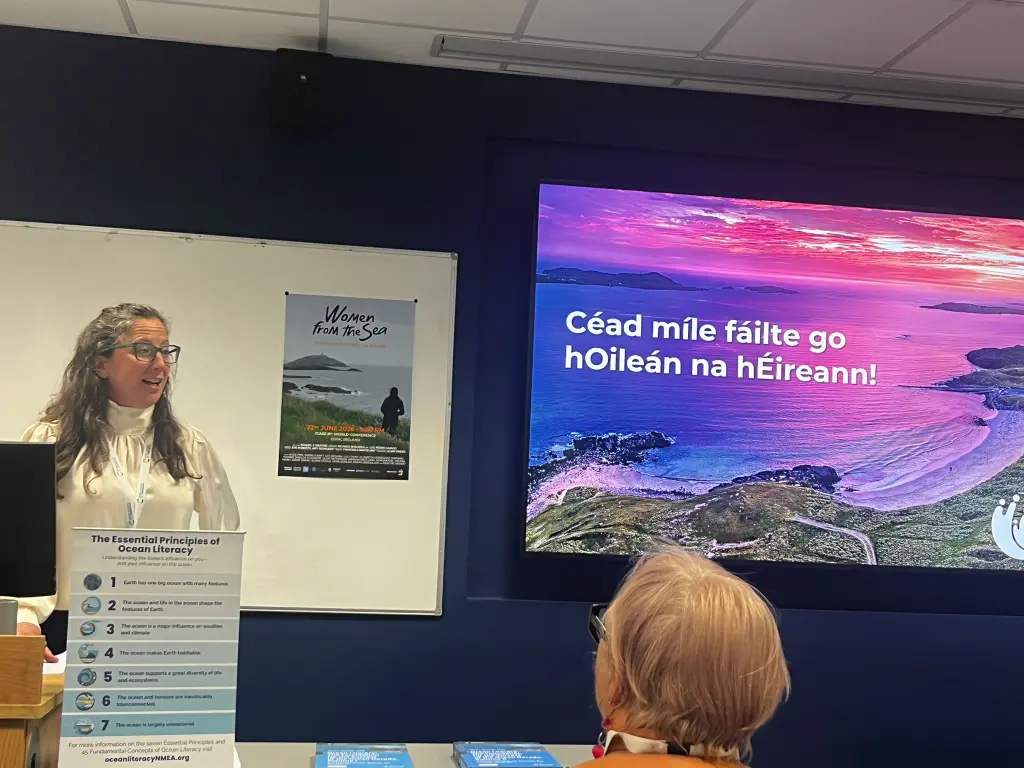
Catherine McCann, IOLN Executive Officer, recently delivered the welcome keynote at Marine Science Education Strand at the 8th ICASE World Conference on Science and Technology Education, hosted by University College Cork. You can read the keynote and view the accompanying slides below.
Celebrating Collaboration for an Ocean-Literate Society
Good afternoon everyone.
Céad míle fáilte go hOileán na hÉireann.
It is a pleasure to welcome you to Ireland and to the Marine Science Education Strand of ICASE 2026.
As Executive Officer of the Irish Ocean Literacy Network, I am delighted to welcome educators, researchers, communicators, policymakers, community leaders and ocean advocates from around the world.
A very special Irish welcome to Teresa Kennedy for your role in organising this event – and welcome also to Francesa Santoro and Raquel Costa from UNESCO, Diz from Canada, Dina from EURO GOOS and Dominika from EMSEA, whose support from afar has been invaluable over the years to us here in the Irish Ocean Literacy community.
It is an exciting week for the ocean literacy community – this week also marks the launch of the book series: Ocean Literacy: The Foundation for the Success of the Ocean Decade.
Volume III, chapter 15 tells the story of the IOLN, one network in one island nation.
But when I look around this room, I don’t see an Irish story.
I see a global story.
I see educators, scientists, communicators, policymakers and advocates who all understand a simple truth: no single organisation, no single discipline and no single country can create an ocean-literate society alone.
And that is what I would like to talk about today.
Not just ocean literacy.
But collaboration.
Because if Ocean Literacy is the foundation of success for the Ocean Decade, collaboration is the foundation upon which ocean literacy is built.
As an island nation, Ireland’s relationship with the ocean runs deep.
The Atlantic shapes our coastline, our climate, our economy, our language, our culture and our identity..
Many of us live within sight of the sea. Many more depend on it, whether we realise it or not.
Yet Ireland also reflects a challenge shared by many countries around the world.
We are surrounded by the ocean, but not always connected to it.
Across Europe and beyond, studies continue to show a gap between the importance of the ocean in people’s lives and their understanding of it.
At a time when we face climate change, biodiversity loss, pollution and increasing pressures on marine ecosystems, that gap matters.
Ocean literacy matters because decisions about the future of our ocean are no longer decisions for scientists alone.
They are decisions for society.
And if society is to make informed decisions, then society must understand its relationship with the ocean.
That is why ocean literacy matters now more than ever.
But creating an ocean-literate society is not straightforward.
Ocean literacy sits at the intersection of education, research, policy, communication, conservation, industry, culture and community action.
No single sector owns it.
No single organisation can deliver it.
No government department can legislate it into existence.
No school curriculum can achieve it alone.
It requires scientists and teachers.
Researchers and storytellers.
Government agencies and NGOs.
Coastal communities and inland communities.
Industry, artists, communicators and citizens.
It requires all of us.
Which means that collaboration is not an optional extra.
It is the only way forward.
The story of the Irish Ocean Literacy Network demonstrates this clearly.
In 2016, a group of people gathered with a shared vision of strengthening society’s relationship with the ocean.
They came from different sectors and backgrounds.
Many had never worked together before.
What united them was a belief that the island of Ireland needed something bigger than a project.
Something bigger than a campaign.
Something bigger than any one organisation.
They decided to build a network.
Looking back over the past decade, that decision may have been the most important one they made.
Because programmes end, projects finish and funding cycles come and go.
But networks create relationships, and relationships endure.
Over the next ten years, the IOLN grew from an informal gathering of passionate individuals into a recognised all-island organisation connecting members from across education, research, government, NGOs, community groups and industry.
The journey was not always easy.
There were periods with very limited funding.
There were years when progress relied heavily on volunteer effort and goodwill.
There were questions about governance, sustainability and future direction.
There was even the constant challenge of explaining what “ocean literacy” actually meant.
Yet the network survived.
And more importantly, it evolved.
One of the biggest lessons we learned was that people stay involved when they see value in one another.
When they can share ideas.
When they can learn from each other.
When they feel part of something larger than themselves.
What emerged was not simply a network.
It became a community of practice.
A place where researchers could learn from educators.
Where community groups could connect with policymakers.
Where local knowledge could sit alongside scientific knowledge.
Where collaboration could flourish.
There were also unexpected successes.
The We Are Islanders campaign reminded us that people connect most strongly through stories.
Regional meetings showed us the power of local voices and local leadership.
International partnerships demonstrated that even a small island nation can contribute meaningfully to global conversations.
And perhaps most importantly, we discovered that a network can act as a neutral space — a place where different perspectives can meet, where trust can be built and where collective action can begin.
But the Irish story is not unique.
The details may differ.
The geography may differ.
The political systems may differ.
But the challenge is remarkably similar across countries.
How do we help people understand their relationship with the ocean?
How do we create opportunities for participation?
How do we bring together different forms of knowledge?
How do we move from awareness to action?
These are questions being explored by people throughout this room.
That is why the Ocean Decade is so important.
Because at its heart, the Ocean Decade is an invitation to collective action.
It recognises that the challenges facing our ocean are too large, too complex and too interconnected for any one organisation, discipline or country to solve alone.
Its success depends on collaboration.
The same collaboration that has shaped the Irish Ocean Literacy Network over the last decade.
So as we begin this conference, I would like to leave you with a challenge.
Over the coming days, attend the presentations.
Share your research.
Discuss your projects.
Celebrate your achievements.
But also look beyond them.
Look for new partners.
Seek out new perspectives.
Start conversations with people you do not yet know.
Build relationships that continue long after this conference has ended.
Because the most important outcome of ICASE 2026 may not be a paper, a presentation or a project.
It may be a connection.
A collaboration.
A partnership that did not exist before this week.
If the story of the Irish Ocean Literacy Network teaches us anything, it is that meaningful change begins when people come together around a shared purpose.
And if we are serious about creating an ocean-literate society, then our greatest resource is not funding, technology or infrastructure.
It is each other.
Thank you, and I wish you a wonderful, inspiring and collaborative conference.