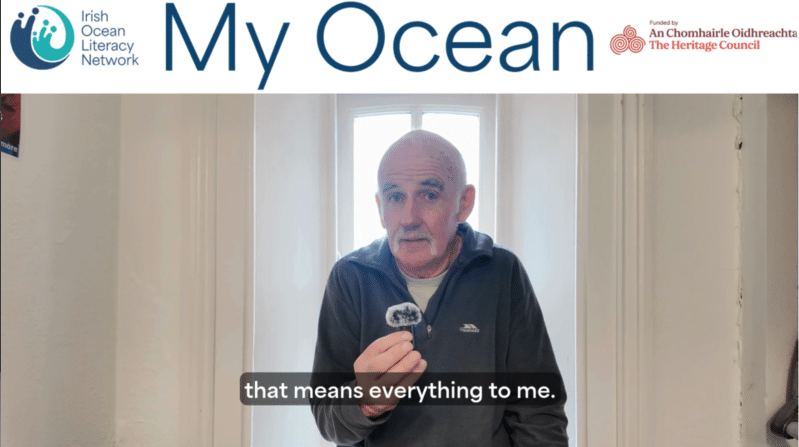
“Hello, my name is Pat Moran. I’m basically an ex-fisherman-come-shellfish producer from the Waterford Estuary.
And as regards the ocean and water, that means everything to me. It means an awful lot more. The land doesn’t mean anything to me. It just means it’s a place that you come and go to. But the important thing is water, is the estuary, the ocean.
And I have been fishing basically all my life, or growing shellfish. And it is a pity that the stocks are not there anymore to sustain an awful lot of the fishing activity that used to go on.
And, yeah. We would have, in the estuary, we would have fished some of the ancient traps that are still there since the 1100s, called weirs. And they would have produced, or caught, the sprats that we use for the fish eels. Which, when I started first, we put them on a train to Billingsgate in England.
And then after that, then there was a Danish man came over, a Ben Knudsen, and he collected them, and put them in a tanker, and brought them to Europe, to Denmark. And after that, then there was Dutch trucks came in, and they’re just the same as milk trucks for all the world. And the eels were alive, and they were collected once every fortnight, and brought to Holland and Europe, for that.
And along with that, everybody did fish salmon, which was a great activity, to be honest! And most of the people in the village—most of the men, anyway, in the village—had done the same. When I started first, there could have been 20 boats with two men in each boat. And there was great activity and life around the place, which is no longer there.
And in between that, then, I probably went on the coast on a trawler, and that sort of thing, and spent a few years out there. And that was grand. And to be honest about it, I found, like—unlike a lot of people—the harder it blew, the happier I was! The bigger it was! I think it was marvelous to be out there, whatever be blowing, and that sort of thing.
And what else? Everybody did fish—apart from the trawling and the fishing the herrings and all that sort of thing—everybody fished whitefish then along with that in the river, along with the cod and eels, or cod and flatfish.
I think it’s nearly the same with everybody: when we used to be fishing salmon, you could be out in the first of the year—you’d fish from September to the 15th of August. And you could be out for a week or weeks without catching any salmon. And then you might catch a salmon. And you’d be so happy looking at that salmon in the bottom of the boat! And it’d make no difference how cold it was, you’d be warm! It was a strange sort of feeling, but you’d be—it was like, it was marvelous, like.
And then, as it went to the peel season—we call it the smaller peel in the summer—then you’d be out there competing with everybody else. So the object of the exercise then was to get as many fish in the boat that nobody else saw was in the boat. Because you’d be trying to get to the same position the next day, and you wouldn’t get to the same position. If you had ten fish and the person not too far away from you only had one, well, he’d be in the position you were in today!
And there was other times, especially early in the year when salmon were very scarce, if you had three or four fish and there was somebody on the beach when you came in, you’d leave the fish in the boat and you’d get out and you’d say, ‘No fish today’! And you’d go home, and then you’d return when it got dark, and you’d bring them up and you wouldn’t say anything to anybody. That was—there was a whole heap of things went on as regards to fishing.
Some of the chaps had it as regards meeting a red-headed woman if you were going to fish, then you could turn around and go home! Not really sure now that was the case anyway, but some people would have—would have believed in that. So it is strange, like, really, to be honest.
I still go out in the water now. I just go messing around, maybe fish a few mackerel or a few bass and cut firewood and that sort of thing. But just to be out there, it is because when you’re out there, you can see everything from otters to seals to gannets, to all kinds of birds. As a matter of fact, after the last time with Karen, that day I brought out Patrick—a chap called Patrick Field came out, he’s into his birds—and we see what was very strange: we see three ospreys, which Patrick says is strange and marvelous and everything into one, like. So it was grand, and they seem to be even more kingfishers knocking around now than was the last few years as well.
So, you know, I think it’s great to be out there. I just think it’s marvelous to be out there on the water. And if I could stay out there, I’d stay out there!