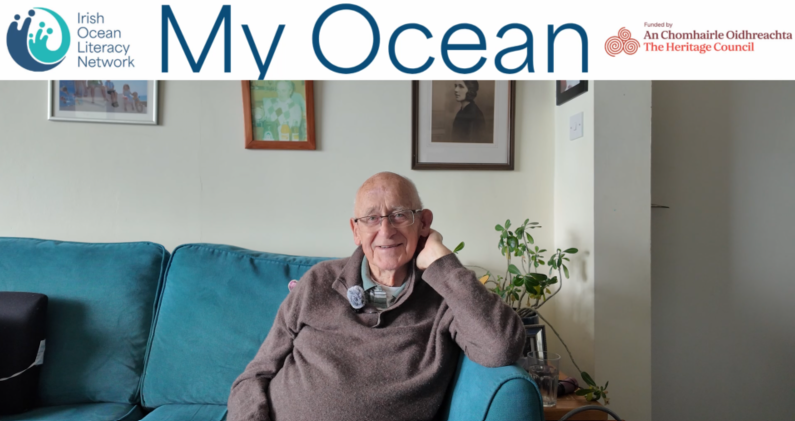
Well, my name is Hugh Fitzgerald Ryan,I’m born in Skerries in 1941, and I’ve lived here most of my life.I worked here as a teacher. So in retirement, I’ve taken up writing and painting, and it keep- keeps me occupied.And give me a reason to get up in the morning, so that’s a good thing.I’m living beside the sea, and it’s been a fascination all my life since I learned to swim.
Now, I was quite late learning to swim.I learned at 11 years of age, and it was a revelation.And my godmother gave me a face mask and a snorkel, and I could see these wonderful forests on, under the water, and little crabs running around, and it was a fascinating area
.But I never developed as such.I never got into diving.Seemed, seemed a bit like hard work, but I’ve been a good swimmer ever since, but not in the winter, I have to admit.I half envy the people that swim all, all year round.And the other half of me says, I’m glad I’m dressed and with a coat on and so it, warm.
But living beside the sea, I was always intrigued by what the food that grew in the sea. I caught crab then, and at the bend, razor, razor clams, which are an acquired taste, and mackerel in summertime.It takes no skill to catch mackerel, you just throw in a hook and they jump onto it.I was never into sailing.I’d go sailing occasionally with a friend, go out around the Rockabill, and that in itself is an interesting place, and the bird life out there was amazing.
So yes, I’d love to be going swimming still, but as you get a bit older, it’s not so easy.But there are more banisters and things now in the bathing places, so I fall a bit less than I used to.I have to be a bit more careful now.I taught kids to swim, I think for about 30 or 40 years, and I got, I found that very satisfying to see a child just taking off. And suddenly discovering that they’re brilliant at it.So there you are.I was never brilliant at it myself, but I used, I used to go in the sea races here.They were handicap races, so I got off, I got off early.So I enjoyed that too, but it made me, it made me strive.Now, when we were young fellows, the rivalry was pretty severe, and you’d be watching your schoolmates to see how they’re getting on and trying to make sure that you were faster.So yeah, that was my swimming career.
So with the painting, I kind of painted the sea in all its moods, and a particular fascination for when the tide is out and you get reflections in the wet sand, and you get the sun rising just opposite my house.And the moon oblige us as well, so there’s always something to look at.And very occasionally, I’d find a nice piece of driftwood and make use of it.And the ban the mantle piece over there, I got that off the island.It’s mahogany, possibly came from Honduras or somewhere, but it was a nice bit of wood, and I couldn’t refuse it, so it does a job now for me at the mantelpiece.
What were summers like growing up in Skerries? Well, you know, it’s funny, but my kids said we never go away on holidays to the seaside, and that’s because we’re at the seaside, and they would get up in the morning and go out on the beach.And, I’d have to go and find them in the evening, and they’d spend the whole day on the beach.And one of the nice things about having small kids is that you get a second chance at making sandcastles and digging canals and all that sort of thing.And I found I was quite good at it as I, as I got older, but I had to follow their instructions.So living by the sea and by the beach was a real bonus.You never had to find entertainment for the kids ’cause they were already doing it.
Yeah, the holiday camp in Skerries is was a very big deal at one time.It opened in 1946 immediately after the war, and it was enormously popular.With English people coming to Skerries because they could get fresh eggs and meat and vegetables, all of which were severely rationed in England, so they loved Red Island, and they’d come for a week or 2.And they’d spend their money in the local shops and pubs, and they’re very good-natured people.And the holiday camp had endless music, and I can still remember some of the stuff.I could even sing it if my voice wasn’t gone.
But it was on all day and a major part of the night, and it was a very big a asset to Skerries.It was built by, Mr. Quinn, the father of Fergal Quinn of the supermarkets.And I think it brought a lot of benefits to the town,and the holiday campers were always around, always in good mood and full of chat.
And like when my own kids were growing up there, again, it was a safe place.You could let them out, and they wouldn’t come to any harm, and then you just have to go and collect them in the evening.Wherever they were got to, but they always enjoyed it.And then they’d say, as they got older, they became teenagers, they’d say, It’s boring.And then they went through that stage, now many of them are living here with their own children, and they think it’s a great place again, so they’re enjoying that.
Well, I’ve only been on Lambay, I think, twice in my life.My brother sailed over there one time.We went along, and we met the people who were living in the castle, and it was intriguing.I think they were glad to see strangers because they wouldn’t see many people passing through, and they had archery.which intrigued me, and the old castle was interesting too.
Ah, yes.We’d sail to the Rockabill and go up, up the lighthouse, which was intriguing.And there’s a lovely little detail there on Rockabill, on the wall of the garden which the lighthouse keepers would cultivate, there’s a groove, and they could put their telescope into the groove, and it focused on a white wall.near the harbor in Skerries.And the families would go out, and they’d signal to the, to the husbands and fathers with semaphore against the white wall, and then they’d put up their telescopes and see the father or the uncle or whoever.on the lighthouse replying to them.
We went to school with quite a few of the lighthouse keepers’ children.They lived at the harbor.And they had a very original house, name for their houses.They were called the dwellings.So they dwelled in the house, the dwellings.Yeah, the big contingent of families passed through.The lighthouses in Skerries and all along the coast, and you’d meet people who had been in, grew up in Donegal or Cork, Connemara, and then they’d come to Skerries, but they didn’t live on the lighthouse themselves.That was for the keepers only.And there was always something going on out there.
Nowadays, it’s helicopters.The helicopter is a regular visitor here, sometime that lifts people off the island if they’re caught by the tide.But the island was always a fascinating place.It was a great adventure.To go there, but if you do, you have to keep your eye on the tide, or you’ll get caught.You’ll have to either have to wade back or get a boat to rescue you.I’ve seen the lifeboat men going out time and again.To pick people up off the island and give them a little lecture on watching the tides and being, being careful not to get caught.But they’re very tolerant men and ladies now, the lifeboat people.They never give out to them because it said, If we do give out to them, we’ll discourage them from ever calling the lifeboat again, so that’ll be counterproductive.
Yeah.So the island had been.A constant fascination to me because it changes all the time.Even today, it’s, the sea is rough, and you’re getting breakers along the dorne, which is, the dorne is the bit that connects the island to the land at low tide, and it’s covered then at high tide.So there’s changing scenery all the time, and great bird life.And of course, there’s Martello Tower on the island, which always intrigued me.I made it the subject of the first book I ever wrote about the soldiers in the Tower, and there were soldiers there until, I think, the 1890s.Their job originally was to look out for Napoleon make sure that he didn’t invade.So they did a good job, and he never came.He never came.Not even for the delights of Skerries.
And there are always stories of shipwrecks along this coast because when you have the easterly gale, it’s blowing everything up onto the coast here, and we’ve had a few famous shipwrecks.Notably, the Taylor, which would be the ship the White Star Line had before they built the Titanic, and this was to be their, their flagship, but it ran aground on Lambay.About 1880s or 90s, I think,because of, it was built of steel, and the steel and the iron in the ship interfered with the compass.So they’re getting the wrong compass bearings all the time.They left Liverpool, and they thought they were going south, and they ran right up onto Lambay Island, and a lot of people were drowned.
But we’ve had fishing boats wrecked here as well.And occasionally, yachtsmen coming in and not being able to get off again.So there’s always something to see when you look out the window.I used to watch a little blue ship going past here, and it went.Up during the week and then down again, up to Drogheada and back down, and I inquired about it, and it belonged to Tyrells, Tyrells of Arklow.They were carrying cement from Drogheada.to the Channel Tunnel.No way.So they did the round trip here once a week and back again for another load.So a lot of that concrete that’s in the Channel Tunnel came from Drogheada via Skerries.
Also, see, there’s a few people here come to watch the birds.There’s one chap comes and he.He categorizes and catalogs all the birds where they nest and where they raise their families along the coast here.He’s very meticulous, and I think he puts his observations up on the Bird Watch Ireland.Website.
There was great excitement here one time, a sooty tern.Was spotted on Rockabill.A sooty tern is a black, a dark gray tern, and it was blown over from Wales, and it created huge excitement with bird watchers coming from all over Ireland.You could go out in 5 in the morning, they were there with cameras and telescopes to watch this bird, a sooty turn, but the other one on the Rockabill is the roseate turn, which, which has, pink plumage on its throat.It’s, I think it’s the only place in Europe where you find this tern.And they’re protected, of course, and if you go over to the island, Rockabill in the summer, there’ll be bird ward- wardens out there.And you know they’re bird wardens because they wear mackintoshes and hats liberally plastered by the birds, and they discourage people from going ashore ’cause they could accept, upset the nestlings.